
Vine Budbreak Does Not Forgive Winter’s Mistakes
1. What Vine Budbreak Is and Why It Matters So Much
Vine budbreak is the first moment of truth of the winegrowing year. Until now, everything was silence. The vine slept, decisions piled up and winter went by without much to see. But when the first buds burst — when the plant wakes and begins to grow — the cycle enters a phase that does not forgive earlier mistakes.
What was done well in winter now shows up as an advantage. What was neglected shows up as a problem. And there is very little that can be done to put it right.
Budbreak does not wait. And it is not forgiving.
2. What Winter Decided Without Warning
Many of the problems of budbreak have their origin in decisions taken — or not taken — in winter. Pruning, done in a certain way, has already determined where and how many shoots will appear. The state of the soil, and how it was managed in autumn and winter, will directly influence the availability of water and nutrients at this moment of peak growth. Preventive plant-health treatments carried out in time protect the buds that are now opening.
The vine does not forget what was done to it — or left undone.
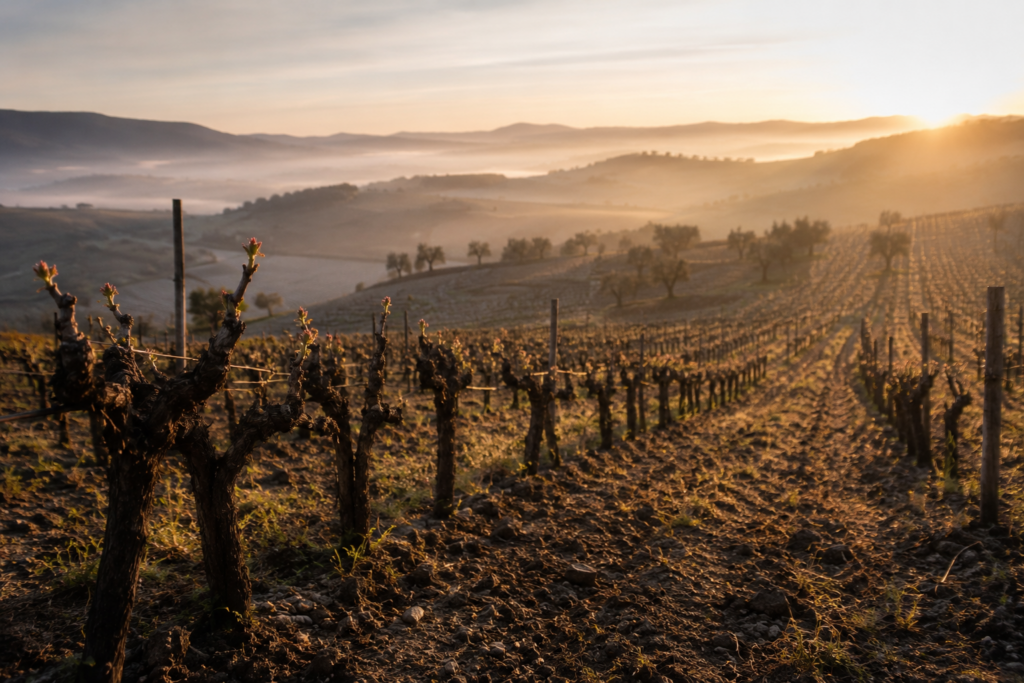
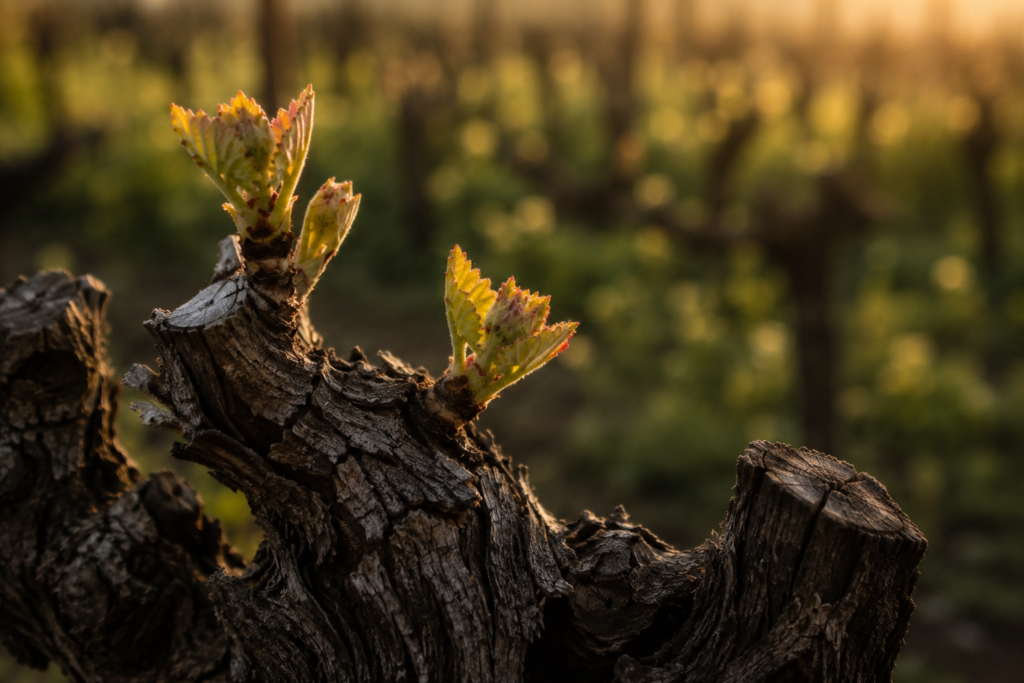
In vine budbreak, the vine reveals everything that winter decided.
3. The Mistakes That Spring Reveals in the Vineyard
It is at budbreak that the problems left unresolved become visible. Pruning that is too late or careless results in uneven budbreak. Compacted or poorly drained soil hinders root development precisely when the roots most need to work.
Cryptogamic diseases — powdery mildew, downy mildew — arrive at exactly this stage. If preventive treatments were not carried out in time, the window for intervention closes quickly.
4. The Vulnerability of Vine Budbreak
The newly emerged shoots are extraordinarily sensitive structures. A late frost — a real risk in many Portuguese regions until mid-April — can destroy in a few hours what took months to prepare.
This is also the moment when the grower needs to be most attentive. Not to intervene hastily, but to observe. The state of the shoots, the uniformity of budbreak, the first signs of fungal attack or of nutritional deficiencies — all of this is read now, at this moment of growth.
5. The Rhythm of Spring in the Cellar
While the vine breaks bud, the cellar enters a period of transition. The previous year’s wines are in their stabilisation phase. Technical tastings intensify. Decisions about blends and assemblages draw near. But the winemaker knows that what happens now in the vineyard will determine what they will have in their hands six months from now. And that demands presence — not only in the laboratory, but out in the field.
6. What Vine Budbreak Means in the Glass
For the consumer, budbreak is invisible. It does not appear in the bottle. It is not written on the label. But it is there, imprinted in every choice the grower made — or did not make — when no one was watching.
A balanced wine, with clean fruit and lively acidity, begins here. On a March or April morning, when the first buds open and the cycle begins again.
7. Conclusion — Spring Does Not Forgive, but It Rewards
Budbreak is viticulture’s test of honesty. It exposes everything left undone. But it also rewards those who worked well — with vitality, uniformity and a potential that, well tended through to the harvest, will result in a wine that tells the story of this moment.
In the vineyard, as in life, there are times when the invisible work is what counts most.
IN THE GLASS
Wines of unmistakable identity. Profiles that exist nowhere else in the world.
AT THE TABLE
Small plates of the land, fish from the coast, cheeses of origin. The table as an extension of the wine’s terroir.
IF YOU WANT TO TASTE THIS
Look for wines made from varieties that almost disappeared. Wines that exist out of stubbornness and conviction — not out of trend.
One example is the Cascale Curtimenta, where the evolution begins in the vineyard itself and reveals itself in the glass with complexity and freshness. The Monte Cascas Reserva Douro Branco shows how precise viticultural work translates into texture and balance. And the 1808 Colheita Beira Interior is proof that well-grown varieties need no excessive intervention.
From the page to the glass
- 1808 Field Blend Beira Interior — An 80-year-old vineyard at 690 metres, 36 months in barrel, cellaring to 2062.
- Cabo da Roca Centenary Vines — Baga from a 96-year-old vineyard, 24 km from the Atlantic. Foot-trodden in lagar.
