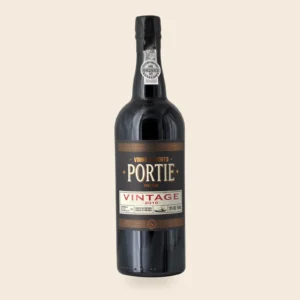
Portie — the house’s Port
The Douro that ages. A whole brand for fortified wine, and here a single bottle: the Vintage.
Port · Douro · Vintage 2010 · around 800 bottles
Why the brand is called Portie
Portie is what Americans call the Portuguese Water Dog.
It is a working dog of the Portuguese coast — it comes from the Algarve and spread along the whole shoreline. It worked the boats: driving fish into the nets, retrieving lost tackle, carrying messages from vessel to vessel and from boat to shore. An animal that worked in the water, alongside the men who lived from it.
Casca Wines was born in Cascais, a fishing town. And Portie also says Port.
That is why we registered the name: it holds two things at once — the sea that made the town where the house began, and the wine that made the region where this one is made. It is also why the brand mark brings together a shell and a dog, and around them the signs of what is in the bottle: the Douro, Port, time.
The shell is not decoration. Cascais comes from cascais — the mounds of shells and husks on its Atlantic beaches. It is the same word that gives the house its name.
One brand, one bottle
Portie was created to hold a whole family of Ports, made in partnership with other houses. Only one of them is on this site.
The Vintage also came out of a partnership, but it is the only one vinified from start to finish by the hands of the house winemaker. That is why it is the only one here: it is not the brand’s most expensive bottle by accident, it is the only one for which we can answer for every decision taken.
Two harvests, and no more
There are two vintages of this wine. 2010, which is on sale. And 2011, which will follow when this one runs out.
Around 800 bottles per harvest. Not staged scarcity, not a campaign limited edition — it is what the fruit chosen for this gave, in the only two years it was made.
What a Vintage is, and why it differs from the rest
A Vintage is a Port from a single year, and it is declared only in years the harvest justifies. It is not a category produced annually by calendar.
And it ages the opposite way to aged tawnies. A 10, 20 or 40 year old lives its life in wood and reaches the table ready. A Vintage spends little time in vat and goes early into bottle — the rest of the ageing happens in there, without air and without wood, slowly. That is why a Vintage is laid down, and why it changes so much across decades.
How it was made
The best grapes of 2010, hand-picked in early September, on Douro schist. Crushed in stone lagares, by foot treading — the old method, still the best way to draw colour and tannin without bruising the seed.
Partway through fermentation grape spirit is added, stopping it and leaving in the wine the sugar that has not yet fermented. That is what makes a Port: it is not sweetened wine, it is wine whose fermentation was halted in time.
20% alcohol. Deep purple-black. Serve at 16–18 ºC.
Ageing: great potential. A 2010 Vintage is, in 2026, at the beginning of its life.