Pruning Is Not a Cut: It Is a Choice for Several Years
1. Introduction — The Gesture That Seems Too Simple
Pruning the vine is, perhaps, the most underrated gesture in viticulture.
At first sight, it looks like a simple act: to cut, to clean, to reduce. A winter task, repeated year after year, often handed over to automatic routines or to quick decisions taken in the cold of the morning. To an outside observer, it is merely maintenance.
But that reading is misleading.
Pruning is not a mechanical gesture. It is a structural decision, with consequences that stretch over several years. Each cut defines not only what will grow.
In a time when people look for quick results and immediate answers, pruning reminds us of an uncomfortable truth: there are choices that allow no shortcuts. And, in the vineyard, almost all the important choices are like that.
This article is born from that realisation. Pruning does not serve to “correct” a difficult year, nor to force yield. It serves to align the plant with time — and time, in viticulture, always plays the long game.
2. The Technical Basis — What Pruning Really Does to the Vine
From a physiological point of view, pruning the vine is the moment when the relationship between vegetative growth and production is defined. By choosing how many buds remain, where they remain and how the wood is structured, we are deciding how the plant will distribute energy throughout the cycle.
Fewer buds does not automatically mean better wine. More buds does not mean greater balance. The quality of the decision lies in its fit to the vigour of the plant, to the soil, to the climate and to the aim of the wine.
Pruning influences:
- the productive load,
- the exposure of the bunches,
- the circulation of the sap,
- the health of the wood,
- and the plant’s capacity to withstand stress over the years.
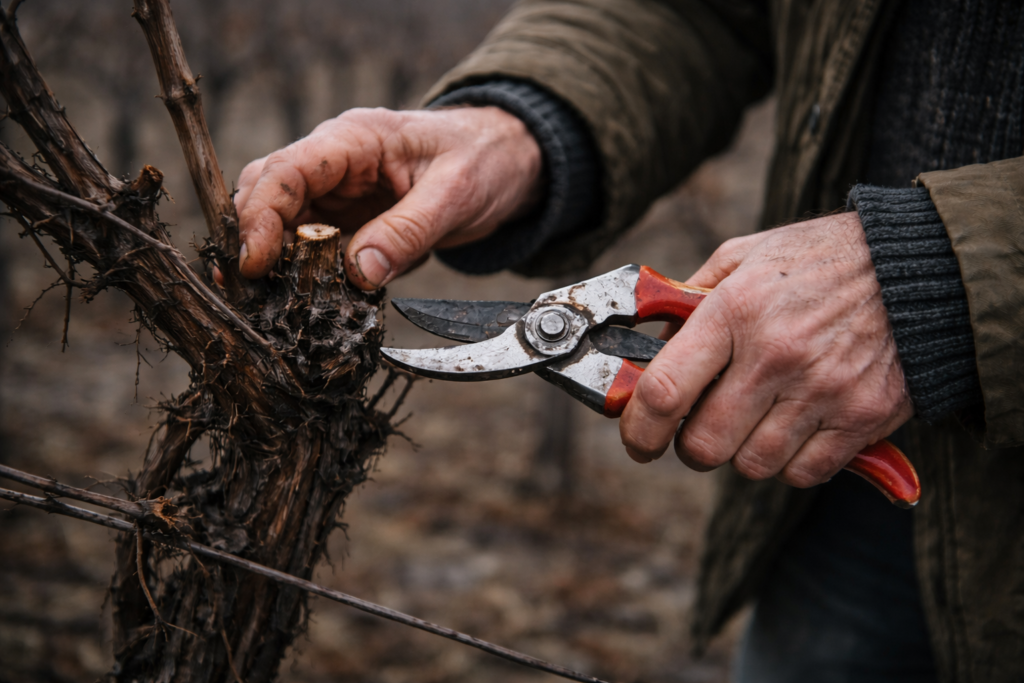
Moreover, the way one cuts matters as much as what one cuts. Badly placed cuts create large wounds, favour wood diseases and compromise the longevity of the vine. Considered pruning reduces future risks — even if that is not visible in the first year.
Here lies one of the great traps: judging pruning only by the immediate result. The vine responds, but it always charges the bill later.
3. In Practice — Deciding Today the Behaviour of Tomorrow
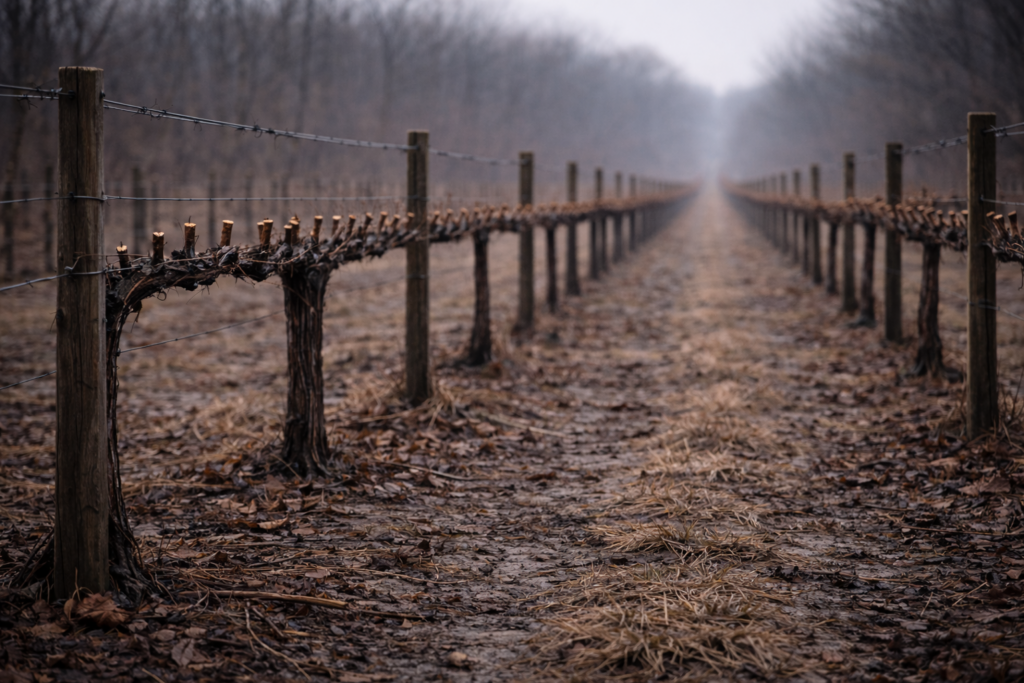
In practice, pruning the vine is an exercise in reading. Reading the plant. Reading the previous year. Reading the place. A vigorous vine does not call for the same approach as a balanced one. A young vine is not pruned like a mature vine. A dry year does not leave the same marks as a rainy one.
It is here that many common mistakes arise:
- pruning the same way in every plot,
- repeating schemes without questioning them,
- pruning in a hurry to “get winter over with”,
- or, on the contrary, trying to correct through pruning what was not well managed before.
Pruning does not solve everything. It remains one stage of a path. If the previous path was poorly thought out, pruning works no miracles.
Another critical point is timing. Pruning early or late has real implications, especially in regions more sensitive to late frosts. But there are no universal recipes. There is context.
In serious viticulture, pruning is not delegated to technique alone — it is accompanied by intention.
4. The Impact on the Wine — The Cut Is Felt in the Glass
It may not be obvious to the consumer, but pruning the vine is clearly felt in the wine.
A well-balanced vine, pruned with consistency over the years, tends to produce more regular grapes, with more even ripening and a better relationship between sugar, acidity and phenolic compounds. That translates into wines with natural structure, contained energy and greater ageing capacity.
In the glass, these wines do not need to impose themselves. They have presence without excess, firmness without harshness, and a finish that holds without tiring.
When pruning is thought out only for yield or immediate impact, the wine tends to give it away: unbalanced alcohol, aggressive tannins, exaggerated but short fruit. These are wines that impress at the first sip and tire quickly.
The consumer rarely associates these deviations with pruning. But, very often, the origin is there — in a past winter of poor decisions.
5. Myths — “Pruning Is Only a Matter of Technique”
One of the most persistent myths is that pruning the vine is merely a technical gesture, almost neutral, that can be standardised. It cannot. Pruning the vine is a cultural choice. It reflects the way the producer views time, risk and ambition. Those who think in long cycles prune differently from those who think in immediate results. Another common mistake is to believe that more severe pruning automatically leads to wines of greater quality. Severity without judgement creates imbalance. Quality is born of fit, not of extremism.
6. Portugal — A Diversity That Forces You to Think
In Portugal, pruning the vine takes on an even more complex dimension.
The diversity of climates, soils, grape varieties and training systems forces you to abandon any idea of a single recipe. What works in an Atlantic vineyard may fail in an inland one. What succeeds at altitude may be a mistake in lower, warmer areas.
This diversity is an advantage — provided it is respected.
Portugal does not call for “correct” pruning. It calls for conscious pruning, adapted to the place and to the aim of the wine. That is what distinguishes projects with identity from merely functional ones.
7. Conclusion — To Cut Is to Take On Consequences
Pruning is not an isolated cut. It is a decision that echoes through time.
Each winter offers the opportunity to align the vine with a clearer, more coherent and more honest vision. But that opportunity exists only for those who accept that wine is not built in a hurry.
Perhaps that is why the most balanced wines rarely come from impulsive decisions. They come from repeated choices, year after year, made with awareness and without shortcuts.
In the vineyard, as in life, what we cut today defines what may grow tomorrow.
Further Reading
To explore this theme further, I recommend three reads on the Winemaker’s Blog: Winter in the Vineyard: When Nothing Happens — and Everything Is Being Decided, where I explore the silent time that prepares the cycle; The Secret of Flavour: How Climate Shapes Wine, on the role of cold and dormancy in the balance of the vine; and Wine Ageing, where time once again takes its central place.
From the page to the glass
- Monte Cascas Vinha do Quinto — 96% Baga from a century-old vineyard, 9,260 vines per hectare, two tonnes.
- Monte Cascas Vinha das Lameiras — A 94-year-old Douro vineyard that yields one tonne. Lagar, 24 months in French oak.
